When a label, recipe, room plan, or weather reading uses an unfamiliar unit, convert it without losing the original meaning. This guide uses four fictional reference sheets to verify one everyday batch: a short length, a land area, a liquid volume, and a temperature. The goal is not just to obtain numbers, but to confirm the dimension, definition, scale, and final rounding.
Start with the Dimension and Definition
Read the unit before reading the number. Length describes distance, area describes a surface, volume describes capacity, and temperature describes a reading on a scale. Enter the source value exactly, including its sign and unit label. For the volume example, “US gal” means a U.S. liquid gallon; it is not interchangeable with an Imperial gallon. That definition determines every later check.
2.54 cm
2.5 ha
1 US gal
-40 °C
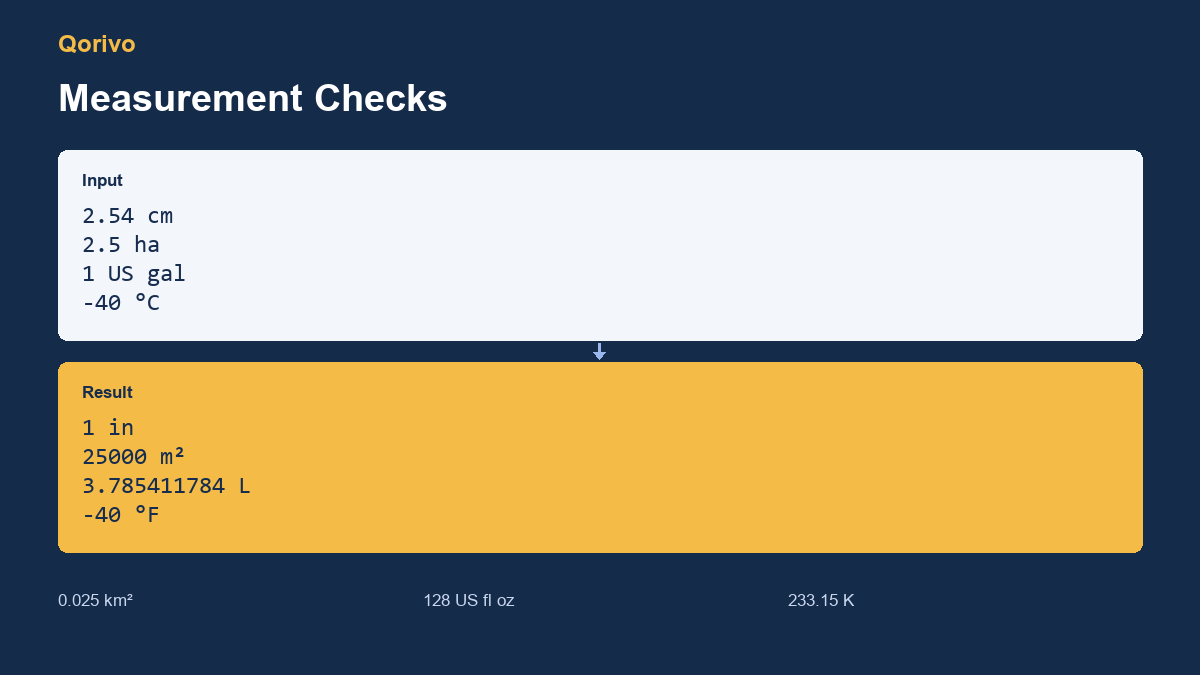
The first fixture contains four separate inputs, so verify each row with the matching converter. Length 2.54 cm should produce 1 in and 0.0254 m. Area 2.5 ha should produce 25000 m² and 0.025 km². Volume 1 US gal should produce 3.785411784 L and 128 US fl oz. Temperature -40 °C should produce -40 °F and 233.15 K.
Walk Through the Expected Output
Use the length sheet for 2.54 cm, then inspect both requested outputs rather than accepting a single familiar result. The area sheet applies the square-unit relationship: 1 ha equals 10000 m², so 2.5 ha equals 25000 m². Dividing by 1000000 converts square metres to square kilometres, giving 0.025 km². These checks preserve the dimension while changing its expression.
1 in
25000 m²
3.785411784 L
-40 °F
The second fixture shows the selected verification outputs in the same order as the sample: 1 in, 25000 m², 3.785411784 L, and -40 °F. Reproduce it by entering each original value in its named source unit, calculating, and comparing the displayed row. For temperature readings, use Fahrenheit = Celsius × 9/5 + 32; at -40 °C, the result is -40 °F.
Sanity-Check Scale and Limits
Use a rough magnitude check to spot the wrong unit before you copy a result. A length of 2.54 cm should be close to one inch. An area of 2.5 hectares is far larger than a room and far smaller than a square kilometre. Check the gallon definition too: 4.54609 L is an Imperial gallon. Even the tool’s cup option has a specific definition of 240 mL.
Round only after the conversion and comparison are complete. Do not add 32 when checking a temperature change: a change of 1 °C equals 1.8 °F. The offset in the formula above applies to readings on the two scales. When you copy a result, keep the original value and unit alongside the rounded answer so the next person can reproduce it.
Finish with a Three-Point Check
- Identify the dimension and exact source definition before entering the value.
- Compare the result with its expected magnitude and supplied reference output.
- Round only the final displayed value, and keep reading formulas separate from change formulas.
